
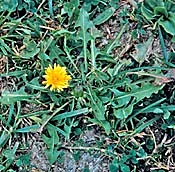
Dandelion: opportunistic in thin turf
Dandelions establish easily in open turf and disturbed areas. Removing the crown and as much of the taproot as practical helps on isolated plants, but the long-term answer is a dense lawn that leaves fewer openings for new seedlings.
Plantain: often associated with traffic and compaction
Broadleaf and buckhorn plantain tolerate compacted conditions better than many desirable turfgrasses. Repeated traffic, hard soil and weak turf can make them persistent. Addressing compaction and turf density is as important as removing individual plants.
White clover: a clue about turf competition
Clover can thrive where turf is thin or fertility is out of balance. Some homeowners tolerate it; others want a uniform grass lawn. Either way, simply removing clover without improving the grass usually leaves room for another weed to occupy the same space.
Crabgrass: an annual that loves open, warm soil
Crabgrass germinates when conditions warm and bare or thin areas give it access to light. It is most visible in summer, but prevention starts earlier with mowing height, turf density and attention to edges and heat-stressed areas.
Ground ivy and violet: persistent in shade and moisture
Creeping ground ivy and violets can be stubborn, particularly in shaded lawns where grass is already at a competitive disadvantage. Improve light where possible, avoid overwatering and consider whether a dense turf lawn is realistic in the darkest sections.
Thistle and other deep-rooted broadleaf weeds need persistence
Canada thistle and similar weeds can spread through extensive root systems. Repeated cutting alone may not solve an established patch. Avoid spreading fragments and focus on a consistent control strategy rather than a one-time cosmetic cleanup.
The strongest weed-control program starts with the turf
Appropriate mowing height, overseeding, soil improvement, proper watering and correction of drainage or compaction issues reduce the empty space weeds exploit. Any pesticide use must follow Ontario rules and the product label; cultural lawn care should remain the foundation.